Best Tarot Spreads for Beginners (Start Here)
You've got a deck. You've done a few single card pulls. Now you're staring at a layout guide with ten positions, Celtic Cross energy, and wondering if you need a master's degree in symbolism to do this.
You don't. Promise.
The best tarot spreads for beginners aren't the elaborate ones — they're the ones that teach you to read, not just memorize positions. Start small. Build intuition. Add complexity when it feels natural, not forced.
Here are five spreads that'll get you there.
1. The Single Card Pull
Yes, one card counts as a spread. It's actually the most underrated practice in tarot.
How it works: Shuffle with a question or intention. Pull one card. That's your reading.
Why it's powerful: With one card, there's nowhere to hide. You can't lean on surrounding cards to "explain" it. You have to sit with this one image, this one message, and figure out what it means for you right now.
Best for:
- Daily practice (morning pull with coffee)
- Yes/no gut checks
- Building card familiarity — one card at a time
Journal prompt: "What is this card reflecting about where I am today?"
Don't skip this one because it seems too simple. Readers who've been at this for years still do daily single pulls. There's a reason.
2. The Three-Card Spread
This is the workhorse. If you learn one multi-card spread, make it this one.
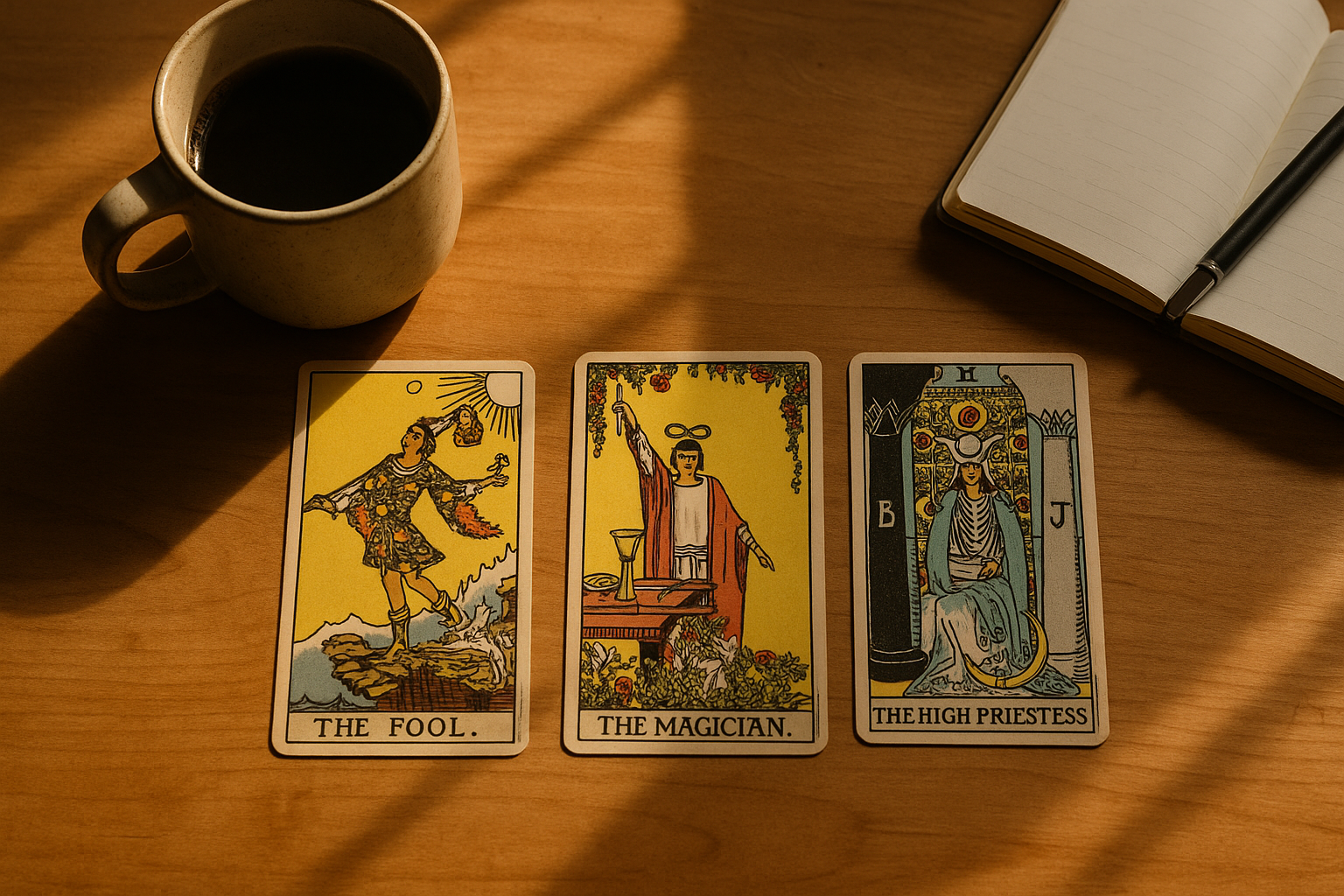
The layout: Three cards in a row, left to right.
Classic interpretation: Past — Present — Future
But here's the thing: you're not locked into that. The three-card spread is a framework. You can assign any three-part question:
- Situation — Action — Outcome
- Mind — Body — Spirit
- What I want — What's blocking me — What I need to know
- Morning — Afternoon — Evening (for a day ahead reading)
Why beginners love it: Three cards give you a narrative without overwhelming you. You start seeing how cards relate to each other — the connective tissue between positions. That's where real reading skill develops.
Journal prompt: "How does the middle card connect the first and last? What story are these three telling together?"
3. The Two-Card Clarity Spread
Sometimes you don't need a story. You need a decision.
The layout: Two cards side by side.
Interpretations:
- Option A — Option B (for decisions)
- Challenge — Advice (for stuck moments)
- What I see — What I'm missing (for blind spots)
- Conscious — Unconscious (for self-awareness)
Why it works: Two cards create tension. They force comparison. Your brain naturally starts looking for contrast and connection — and that's the muscle you're building as a reader.
Journal prompt: "What's the relationship between these two cards? Are they in conflict or conversation?"
4. The Week Ahead Spread
Once you're comfortable with three cards, this is a natural next step.
The layout: Seven cards in a row (or arc), one for each day of the week.
How to read it: Pull on Sunday evening or Monday morning. Each card represents the energy or theme of that day. Don't try to predict events — think of each card as a lens for the day.
Why it's great for learning: You get seven mini-readings in one session, and you can check each card against what actually happened. By the end of the week, you've had seven opportunities to test your interpretation skills.
The real power: Review at the end of the week. Which cards were spot-on? Which ones surprised you? Which ones made sense only in hindsight? This is accelerated learning.
Journal prompt: Log each day briefly as it happens. At week's end: "Which card-day pairing taught me the most?"
5. The Four-Card Check-In
This one's less traditional but incredibly practical for journaling.
The layout: Four cards in a square.
| Card 1: What's working | Card 2: What's not | |---|---| | Card 3: What I need | Card 4: What to release |
Why it's useful: It's structured self-reflection with tarot as the prompt. No mystical question needed — just "how am I doing?" The four positions cover enough ground to surface something meaningful without requiring advanced reading skills.
Best for: Weekly or monthly check-ins. It's especially good when you feel "off" but can't articulate why.
Journal prompt: "Card 4 — what am I holding onto that this card is asking me to let go of?"
How to Choose Which Spread to Use
Don't overthink this:
- Quick guidance? Single card.
- Need a story or trajectory? Three cards.
- Making a choice? Two cards.
- Planning the week? Seven cards.
- General check-in? Four-card square.
As a rule: match the spread size to the size of your question. "What should I focus on today?" doesn't need seven cards. "What's the overall energy of my week?" doesn't work with one.
Common Beginner Mistakes with Spreads
Jumping to Complex Spreads Too Fast
The Celtic Cross is iconic. It's also ten cards with nuanced position meanings that interact in non-obvious ways. If you're new, it's more likely to confuse than clarify. Build up to it. You'll get there.
Ignoring the Positions
Each position in a spread has a meaning. The same card in the "challenge" position reads very differently than in the "advice" position. Don't just interpret cards in isolation — read them in their seats.
Not Journaling the Spread
A spread you don't record is a spread you'll forget by tomorrow. Even three sentences per reading builds something you can learn from later.
Doing Too Many Readings
Pulling cards five times about the same question because you didn't like the first answer isn't practice — it's avoidance. One reading per question. Sit with it.
Building Your Practice
Here's a simple progression that works:
Weeks 1-2: Daily single card pulls. Journal every one. Focus on building your personal relationship with the cards.
Weeks 3-4: Add a weekly three-card reading. Try different position meanings each time.
Month 2: Incorporate the week ahead spread. Start comparing your card predictions to what actually unfolded.
Month 3+: Experiment. Try the four-card check-in. Create your own position meanings for three-card spreads. Start noticing which spreads feel most useful to you.
There's no rush. The reader who does one thoughtful single-card pull daily will develop faster than the one who does elaborate spreads without reflecting on them.
Start With What You Have
You don't need a special cloth, a dedicated altar, or a perfectly quiet room. You need a deck and something to write in — or type in.
Pull a card. Write down what you see. Do it again tomorrow.
That's how a practice starts. The spreads just give it shape.